Table of Contents Show
Walk into any electrical shop in Malaysia and the first thing you’ll notice is that most air conditioners look more or less the same. Same white panel, same remote, same wall mount. What actually separates them is horsepower and picking the wrong one is one of the most common and costly mistakes homeowners make.
Too small, and your aircond runs flat out all day without ever reaching the temperature you set. Too big, and you’re paying more upfront and on your electricity bill for a unit that’s overkill for the space. Neither situation is comfortable, and both shorten the lifespan of the unit.
This guide covers what HP actually means, how to match it to your room, and what other factors Malaysian homes need to account for beyond just floor area.
Key Takeaways
- HP (horsepower) determines an air conditioner’s cooling capacity, the higher the HP, the larger the space it can effectively cool.
- Room size is the starting point for choosing HP, but ceiling height, sun exposure, and floor direction all affect the final decision.
- An undersized unit runs continuously and struggles to cool, while an oversized unit short-cycles and fails to dehumidify properly.
- For most Malaysian bedrooms, 1HP covers smaller rooms up to around 100 sqft, and 1.5HP handles standard rooms up to roughly 200 sqft.
- A 2HP unit is typically reserved for living rooms, large master bedrooms, or open-plan spaces above 250 sqft.
What Does HP Actually Mean in an Air Conditioner?
HP stands for horsepower, and in air conditioning it refers to the unit’s cooling capacity. The higher the HP, the more heat the unit can remove from a room per hour. In technical terms, cooling capacity is measured in BTU per hour, roughly, 1HP equals about 9,000 to 10,000 BTU/hr.
What this means in practice: a 1HP unit and a 2HP unit both cool air, but the 2HP unit removes heat from the room roughly twice as fast. In a room that’s the right size for it, that translates to reaching your set temperature faster and maintaining it more efficiently. In a room that’s too small for it, that extra capacity just causes problems.
HP does not directly tell you about energy efficiency. A 1.5HP inverter unit can use less electricity than a non-inverter 1HP unit running at full load, depending on usage patterns. HP and energy rating are separate considerations — both matter, but for different reasons.
Source: cuckoo
Room Size Guide: Which HP Covers Which Space
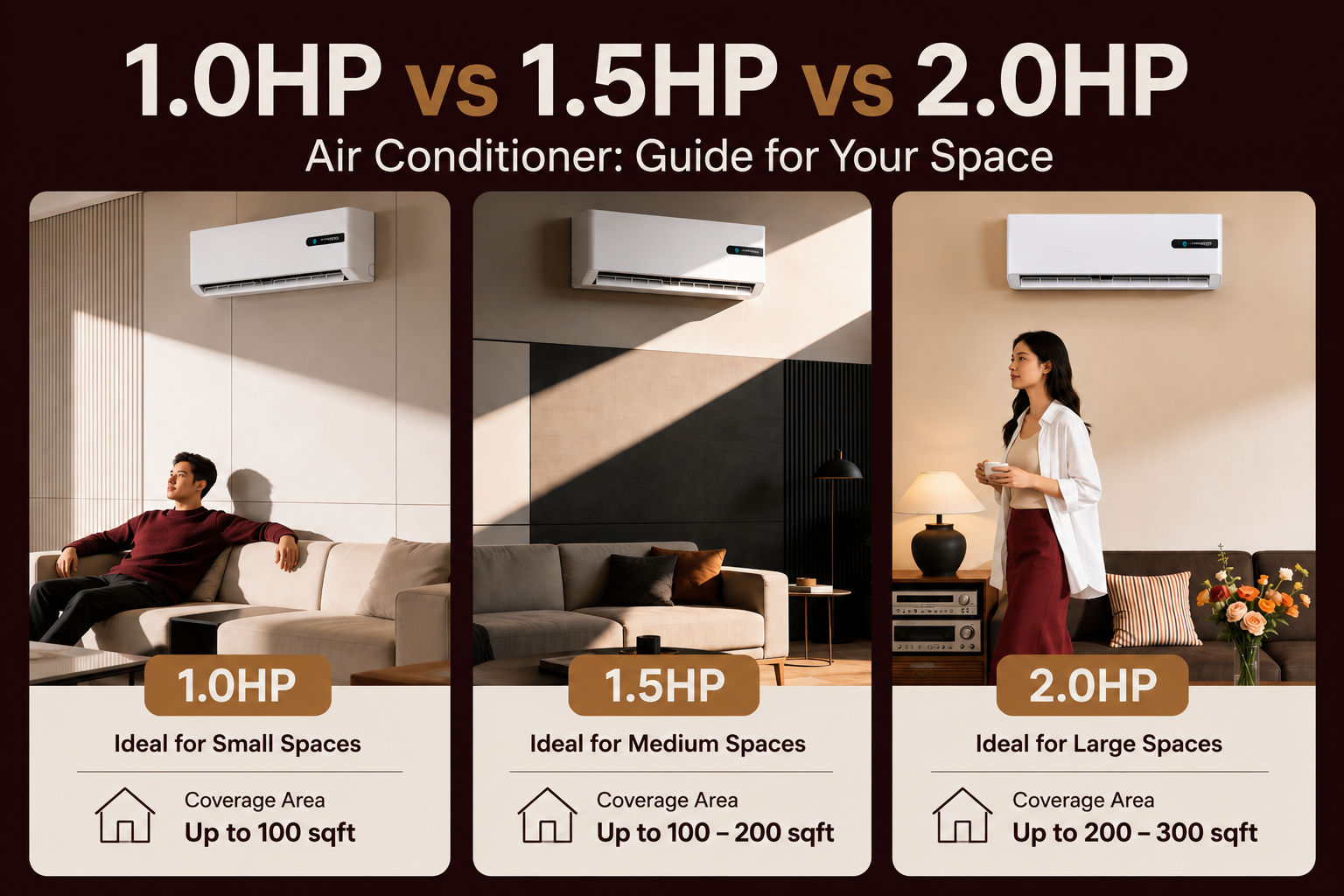
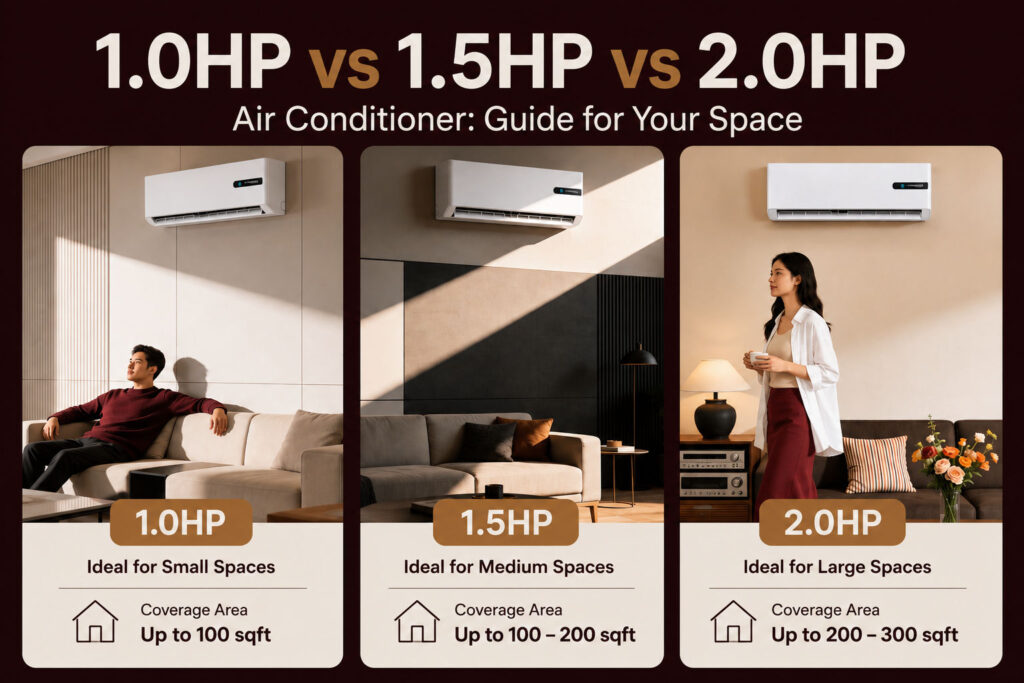
This is the most straightforward part of the decision. Match the HP to your room’s floor area using this as a baseline:
| HP | Approx. Cooling Capacity | Room Size (sqft) | Room Size (sqm) | Typical Room Type |
| 1.0 HP | ~9,000 BTU/hr | Up to 100 sqft | Up to ~9 sqm | Small bedroom, study room |
| 1.5 HP | ~12,000 BTU/hr | 100 – 200 sqft | 9 – 18 sqm | Standard bedroom, master bedroom |
| 2.0 HP | ~18,000 BTU/hr | 200 – 300 sqft | 18 – 28 sqm | Large master bedroom, living room |
These ranges assume a standard ceiling height of around 10 feet, moderate sun exposure, and reasonable insulation. If your room doesn’t fit neatly into those assumptions, the next section explains how to adjust.
A useful rough formula: multiply your room area in sqm by 500 to get an approximate BTU requirement, then convert to HP. A 15 sqm room needs around 7,500 BTU/hr, which puts it comfortably in 1HP territory. A 20 sqm room at 10,000 BTU/hr sits right at the edge of 1HP, and is usually better served by a 1.5HP unit.
Other Factors That Affect the HP You Actually Need
1. Ceiling Height
Standard ceiling height is assumed to be around 10 feet. Double-volume living rooms, older landed properties with high ceilings, or loft-style spaces hold significantly more air volume than the floor area suggests. If your ceilings are above 12 feet, size up.
2. Sun Exposure and Floor Direction
This one matters a lot in Malaysia. A west-facing room that receives direct afternoon sun from 2pm onwards builds up heat load considerably faster than a north-facing room of the same size. If your bedroom or living room faces west and has large windows, add roughly 10% to your BTU requirement. That often means going up one HP tier. East-facing rooms get morning sun, which is less intense by the time it hits the wall, so the impact is smaller.
3. Floor Level and Roof Exposure
Top-floor units in apartments or terraced houses absorb heat through the roof, especially in the afternoon. If your room is directly under the roof with no ceiling insulation or roof space to buffer the heat, expect a higher cooling load than the floor area alone would suggest. Ground-floor rooms tend to be cooler naturally.
4. Number of Occupants and Heat Sources
Every person in a room adds body heat. A bedroom with two adults generates more heat than an empty study of the same size. Rooms with desktop computers, gaming setups, or other electronics running continuously add to the load as well. If your room regularly has three or more occupants or significant electronics, factor that in.
5. Insulation and Window Size
Newer condominiums with double-glazed windows and good wall insulation retain cool air more effectively than older buildings with single-pane windows and thin walls. If your space has large glass panels or sliding doors that face sunlight, the heat gain is substantial and a higher HP unit performs better.
The Cost of Getting the Size Wrong
Getting the HP wrong in either direction creates real problems — not just minor inefficiencies.
Too Small
This one surprises people because the assumption is that more power means better cooling. What actually happens is the opposite. A unit that’s too large for the room blasts it cold within minutes, then shuts off — before it has had enough time to pull the moisture out of the air. In Malaysia’s humidity, moisture in the air is half the problem. So you get a room that hits a low temperature quickly but still feels sticky and clammy. The unit then kicks back on, cools fast, shuts off again, and repeats. This stop-start pattern wastes electricity and puts unnecessary stress on the compressor over time.
Bigger does not mean better. The right size for your room is the one that runs efficiently through complete cycles.
Too Big
Oversizing is a less obvious problem, but it causes its own headaches. A unit that’s too powerful for the room cools it down so quickly that the compressor shuts off before completing a full cycle. This is called short cycling. The issue isn’t just energy waste. Short cycling means the air conditioner doesn’t run long enough to properly dehumidify the room.
In Malaysia’s humidity, that results in a room that feels cold but damp, a clammy, uncomfortable experience even at low temperatures. Frequent on-off cycling also puts wear on the compressor over time. Bigger does not mean better. The right size for your room is the one that runs efficiently through complete cycles.
Which Air Conditioner HP Should You Pick For Your Space?
If you’re buying a standard Malaysian apartment or terraced house, here’s a practical breakdown.
1.0 HP Air Conditioner
1HP air conditioner suits a small bedroom, a study, or a single-occupant room up to about 100 sqft with no unusual heat sources or sun exposure. It’s the most energy-efficient choice for the right room size, and the lower upfront cost makes sense if the room genuinely doesn’t need more capacity. CUCKOO’s VITA 5TAR 1.0HP Inverter fits this category with inverter-driven for efficiency, and sized for rooms that don’t need heavy-duty cooling.
1.5 HP Air Conditioner
1.5HP is the most versatile size and the right call for most standard Malaysian bedrooms, including master bedrooms in the 150 to 200 sqft range. It also works well for west-facing rooms or rooms with higher ceilings that would otherwise push the upper limit of a 1HP unit.
If you’re unsure between 1HP and 1.5HP, the 1.5HP is almost always the safer choice for comfort. The VITA 5TAR 1.5HP Inverter covers this range and runs on the same inverter platform for consistent efficiency.
2.0 HP Air Conditioner
2HP is for living rooms, open-plan spaces, and large master bedrooms above 200 sqft. It’s also the practical choice for any room with significant sun exposure, high ceilings, or consistent occupancy throughout the day. Don’t default to 2HP for a bedroom unless the room genuinely calls for it since the electricity consumption is considerably higher.
If your room sits right at the boundary between two HP tiers, you should need to consider the factors of the sun direction, ceiling height, and insulation to guide your decision. When in doubt, sizing up is generally better than sizing down.
Conclusion
HP is a starting point, not a complete answer. A 1.5HP inverter unit in a properly insulated, north-facing bedroom will outperform a 2HP non-inverter unit in the same room on both comfort and electricity cost. The size matters, but so does the technology, the installation quality, and how well the unit is maintained over time.
Use your room measurements as the baseline, adjust for the factors specific to your home, and resist the instinct to just buy bigger. Matching the unit to the room is what delivers the cooling efficiency and electricity savings that inverter technology promises.